What Room Size Does Epicooler Really Cool?
51 m² advertised, 15 to 40 m² in reality: we explain the gap and how to pick the right room.

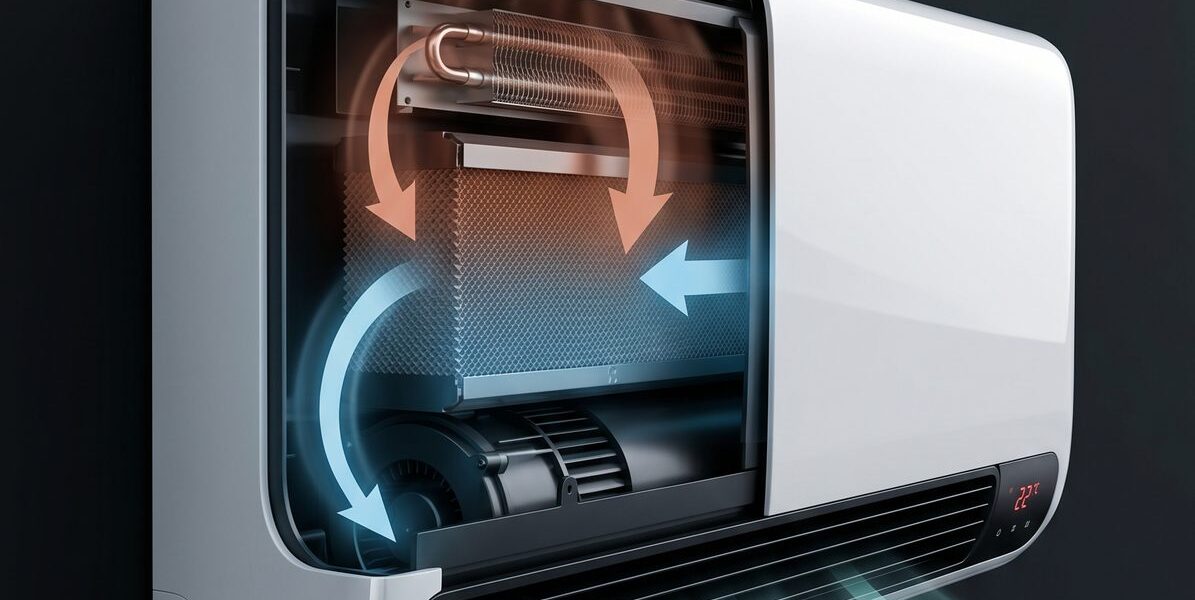
The manufacturer advertises up to 51 m². In real life, Epicooler gives its best results over 15 to 40 m², in a normally insulated, standard-ceiling room. Beyond that, the effect dilutes. It’s not a lie, it’s the nature of an evaporative cooler: it cools a zone around itself, not an unlimited volume.
“51 m², really?” It’s the trick question, and the source of plenty of disappointment when ignored. Here’s how to read that figure, and which room actually suits Epicooler.
Why an advertised area is always optimistic
Maximum advertised areas — for Epicooler as for any cooler — assume ideal conditions: well-insulated room, standard ceiling, dry air, well-placed unit, openings closed. It’s a theoretical ceiling, not a guarantee. As soon as you move away from those conditions — large glazing, high ceiling, humid air, a through-room — the area actually cooled shrinks. Nothing abnormal: it’s the physics of evaporative cooling.
Think in volume, not just floor area
A detail most spec sheets skip: what matters is the volume of air (floor area × ceiling height), not just the square metres. A 25 m² room under a 2.5 m ceiling is ~62 m³; the same area under 3.2 m climbs to 80 m³, nearly 30% more air to cool. At equal floor area, a low ceiling is far more favourable.
Effective area in practice
| Room | Area | Expected effectiveness |
|---|---|---|
| Bedroom, office | 9–18 m² | Excellent |
| Living-room corner, studio | 18–35 m² | Good |
| Large living room | 40–51 m² | Decent near the unit |
| Open-plan, high ceiling | > 51 m² | Insufficient |
An evaporative cooler’s logic is one of localised cooling: the closer you are, the more you feel the cold. In a bedroom or office, it’s perfect. In a large living room, place it near the living zone rather than expecting every corner to cool.
The factors that change the result
- Air humidity: above ~70%, evaporation slows and the effect fades. Epicooler is at its best in hot, dry air.
- Insulation and sun: an unshaded west-facing room heats up faster than it cools.
- Ceiling height: the higher it is, the more volume to treat.
- Placement: close to you, openings closed during the hot hours.
How to get the most from the coverage
- Close the room: less volume exchanged with the rest of the home, more effect.
- Place the unit facing the zone to cool, not in a dead corner.
- During the hottest hours, lower shutters and curtains to limit solar gain.
- For a large room, accept zone cooling rather than uniform — or add a fan to spread the cool air (see Epicooler or a fan).
Which room to pick for Epicooler?
If you keep just one rule: Epicooler is for the room where you spend time, not the whole home. Bedroom, home office, studio, sofa corner — that’s where it shines, and it’s exactly the profile of small spaces and rented homes. Sized right, it keeps its promises, as our full Epicooler review shows. Sized wrong (too large a room), it disappoints — like any device used outside its remit.
Ready to grab the Epicooler deal?
30-day trial, money-back guaranteed. If Epicooler doesn’t win you over, it goes back free.
What room size can Epicooler cool?
Its best results are between 15 and 40 m² (bedroom, office, living-room corner). The advertised 51 m² assumes ideal conditions; beyond that the effect dilutes.
Can Epicooler cool a whole flat?
No. It’s a one-room backup device. For several rooms, you move it — which is easy — or opt for an air conditioner.
Why is Epicooler less effective in a large room?
Because an evaporative cooler cools a zone around it. The larger the volume (area × height), the more the cool air dilutes. Placing it close to you partly compensates.

The Epicooler team tests, measures and compares portable climate-comfort gear to help you choose without getting it wrong.
Honest Epicooler tests, before you buy.
Get our hands-on tests and buying guides on Epicooler — no hype, no spam.