Epicooler or a Fan: Which Should You Choose?
A fan stirs the air, Epicooler cools it. The honest match-up for when one is enough and when the other wins.


A fan stirs the air; Epicooler cools it. If your room is already stifling, a fan just moves warm air around — Epicooler genuinely lowers the temperature it blows, by evaporation, and even heats in winter. The fan keeps two advantages: a lower entry price and minimal power use. For real backup comfort, Epicooler goes further.
It’s the match-up that runs through everyone’s head: “why pay more than a fan?” Because the two don’t do the same thing. Here’s the difference, plainly.
The fundamental difference
A fan produces no cold. It creates an airflow that speeds up the evaporation of your sweat — hence the feeling of freshness on the skin. But the room temperature itself doesn’t move: if the room is 31 °C, you get 31 °C in motion. As soon as it’s genuinely hot, or you’re not directly in the flow, the effect vanishes.
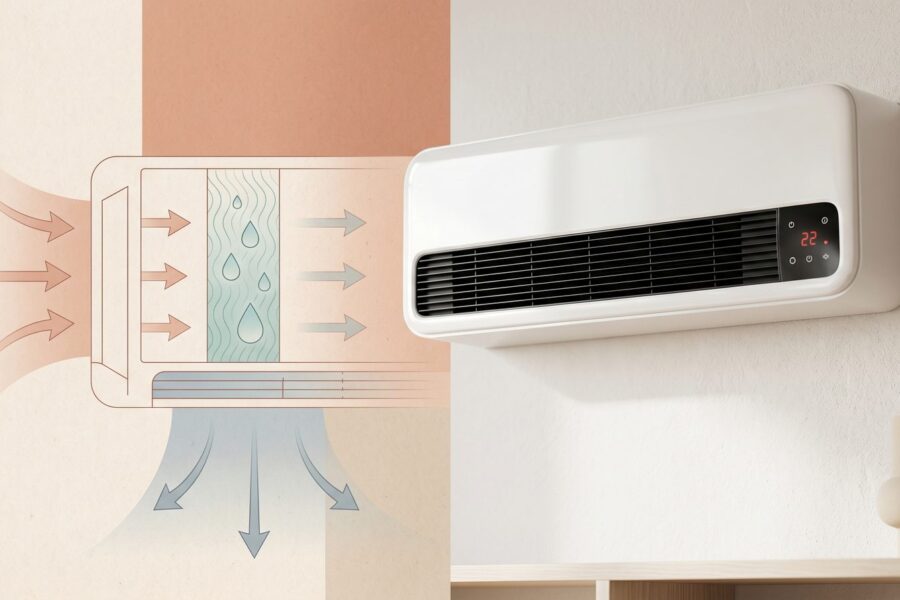
Epicooler adds a step: the air passes over a damp pad and comes out genuinely cooler (we explain it in how Epicooler works). The blown air is below the room temperature. It’s not an AC, but it’s not just a draught either.
Fan vs Epicooler: the table
| Criterion | Fan | Epicooler |
|---|---|---|
| Cools the air? | No | Yes (evaporation) |
| Heats in winter? | No | Yes (PTC ceramic) |
| Power use | Minimal | Low |
| Noise in night mode | Variable | Quiet (~35 dB) |
| Water to refill? | No | Yes (tank) |
| Effect when not in front of it | Weak | Real (cooler air) |
When to keep a fan
- An occasional draught of air and a very tight budget.
- A room that’s already cool, where you just need to circulate the air.
- Very humid air, where evaporation loses effectiveness.
When to move up to Epicooler
- A room that overheats and where the fan no longer cuts it.
- A need for genuine felt cooling, not just a breeze.
- The wish for a device useful all year thanks to the heating.
- A desire for discreet night-time use — see Epicooler’s noise level.
The best combo: both
Plenty of users actually keep both: the fan spreads the cool air produced by Epicooler across the whole room, extending the comfort zone. It’s a simple, effective trick our Epicooler test confirms. To place Epicooler against the other options, see also our comparison of Epicooler alternatives.
More than a fan, without the AC
Real cool in summer, warmth in winter, no installation. Check the current offer.
Is Epicooler better than a fan?
For cooling, yes: it lowers air temperature by evaporation, whereas a fan only moves the room air. It also heats in winter, which a fan never will.
Does a fan cool the air?
No. It creates a feeling of freshness on the skin by speeding up sweat evaporation, but the room temperature doesn’t drop.
Can you use a fan with Epicooler?
Yes, it’s even a good combo: the fan spreads the cool air produced by Epicooler across the whole room.

The Epicooler team tests, measures and compares portable climate-comfort gear to help you choose without getting it wrong.
Honest Epicooler tests, before you buy.
Get our hands-on tests and buying guides on Epicooler — no hype, no spam.